

Child Development
What Is the EYFS Framework and What Does It Mean for Your Child at Nursery?
Written by Vivian, Owner & Director at Blossoming Minds Daycare
Parents often ask us what the EYFS actually is. They have seen the letters on our website or heard them mentioned at a settling-in session, but the full name, the Early Years Foundation Stage framework, does not always make things much clearer. So here is a plain-English guide to what it covers, why it exists, and what it looks like day to day in our nursery.
What the EYFS framework is
The EYFS is the statutory framework that governs the education and care of all children from birth to age five in England. Every registered nursery, childminder, and reception class must follow it. It sets out the areas of learning and development that practitioners are expected to support, the welfare and safeguarding requirements that must be in place, and how children's progress should be observed and assessed.
You can read the full document on the EYFS statutory framework page if you want to go into the detail, but most parents find it more useful to understand how it translates into a real nursery day.
The seven areas of learning
The EYFS organises children's development into seven areas. Three are described as prime areas, meaning they are seen as foundational and develop earliest:
- Communication and language – listening, understanding, and speaking
- Physical development – moving confidently, handling tools and materials, and developing healthy habits
- Personal, social and emotional development – building relationships, managing feelings, and growing in confidence and independence
Then there are four specific areas, which build on the prime areas as children grow:
- Literacy – early reading and writing
- Mathematics – numbers, patterns, shape and measure
- Understanding the world – people, places, communities and the natural world
- Expressive arts and design – creativity through music, art, movement and storytelling
What matters most is that these are not separate subjects taught in separate lessons. In good early years practice they weave through everything children do. When one of our children helps our chef in the kitchen, they are working on language, maths, physical skills and understanding the world, all at once. That is the point.
What it looks like at Blossoming Minds
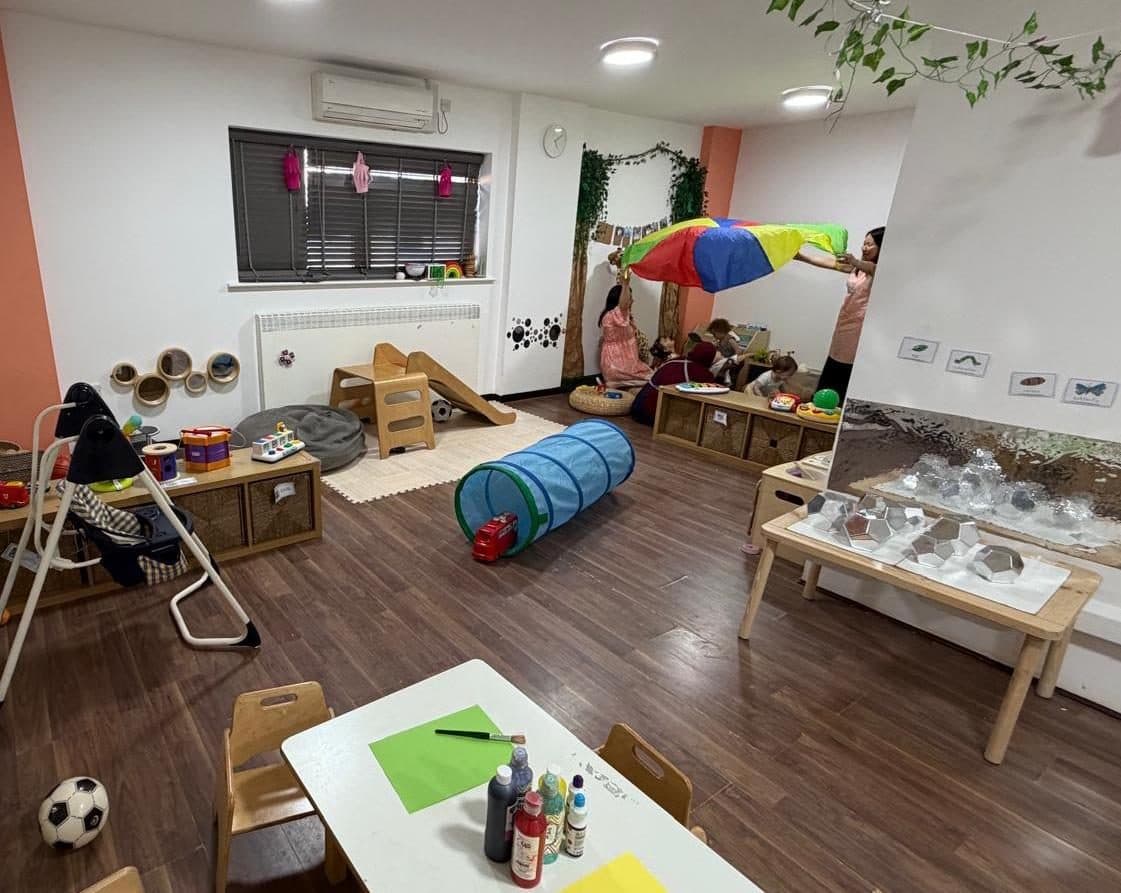
At Blossoming Minds Daycare in Greenwich, the EYFS shapes our whole approach, but we try not to let the framework itself become the thing children see. What they see is a nursery day that follows a calm, unhurried rhythm: breakfast together, child-led play, small group activities, time outside every day whatever the weather, and proper mealtimes with food prepared fresh by our in-house chef.
We use what we observe about each child to inform what we offer them. If a two-year-old is fascinated by construction at the moment, we will follow that interest with books, outdoor building, small world play and conversation. None of that looks like formal learning, but it is covering communication, mathematics, physical development and more, in a way that genuinely engages that child.
Our Energy Hub, an indoor grassed area we use for active play, gives children a space to move, climb and explore even when the weather makes outdoor time difficult. It sounds like fun, and it is, but it is also directly supporting the physical development strand of the EYFS.
The role of your child's key person
Every child at our nursery has a key person. This is a requirement of the EYFS, but it is also, in our experience, one of the most important things we do. Your child's key person gets to know them properly before you step back during settling in. They observe your child regularly, build a picture of how they are developing across the seven areas, and use that to plan activities and experiences that are right for that particular child.
This is also the person who keeps you in the loop. We share updates throughout the day, including photos, so you can see what your child has been doing and how they are getting on. It is not about generating paperwork. It is about making sure you feel genuinely connected to what is happening.
Assessment: what it is and what it is not
The EYFS includes a progress check at age two and an assessment at the end of reception year. In between, practitioners make regular observations. In our nursery, these observations are woven into the day rather than interrupting it. We are watching children play, talking to them, noticing what they can do and what they are reaching towards. That informs what we plan next.
It is worth saying clearly: the EYFS is not about pushing children towards formal learning before they are ready. It is built around the understanding that play is how young children learn best, and good early years practice works with that rather than against it.
How funding fits in
Most families in Greenwich will be eligible for some funded childcare hours. Every three and four year old gets 15 hours per week of universal free entitlement, regardless of work status or income. Eligible working families can access up to 30 hours per week, and since September 2025 this is available from nine months old. We accept both the 15 and 30 hours funding at Blossoming Minds. You can find more detail, including how we apply funding to your sessions, on our fees and funding page.
If you would like to see how we bring the EYFS to life in practice, the best way is to come in. You are welcome to book a show-around at a time that suits you, and have a proper look around with the chance to ask questions. If you would prefer something more relaxed first, our free weekly Stay and Play session every Friday morning is open to children from three months to three years, and parents stay for the whole session. You can register for Stay and Play with no commitment.
Come and see us for yourself
Book a relaxed tour of Blossoming Minds Daycare and meet our team.
Book a tourOther guides you might like
Choosing a Nursery
How to Join Blossoming Minds: A Step by Step Guide
Everything that happens from your first enquiry to your child's first day, including tours, applications, funding and getting set up on Famly.
School Readiness
Is My Child Ready for Nursery? School Readiness Explained
School readiness is about much more than knowing colours or counting to ten. Here, I share what it actually means in practice and how nursery helps children build the foundations they genuinely need.
Settling In
Separation Anxiety at Nursery Drop-Off: What Helps and What to Expect
Saying goodbye at the nursery door is hard for many families. Here, I share what we see day to day at Blossoming Minds and what genuinely helps children settle.
Frequently asked questions
Does following the EYFS mean my child will be sat doing worksheets?
Not at all. The EYFS is built around the understanding that play is how young children learn best. In our nursery, learning happens through cooking, building, outdoor exploration, stories and conversation. Structured activities have their place, but child-led play sits at the heart of our day, and that is entirely in keeping with what the framework asks for.
How does Blossoming Minds track my child's development without it feeling like constant testing?
We observe children as part of normal nursery life rather than setting formal assessments. Your child's key person builds up a picture over time through watching, talking and playing alongside them. You receive regular updates and photos throughout the day, so you are part of that picture too. It is meant to feel natural, because for young children it genuinely needs to be.
My child is only one year old. Does the EYFS apply to them too?
Yes, the EYFS covers all children from birth to five. For babies and very young toddlers, the prime areas of communication, physical development, and personal, social and emotional development take centre stage. Everything we offer at Blossoming Minds, including our settling-in process and key person approach, is shaped with these earliest stages of development in mind.
Can I come and see how the nursery works before I decide whether to apply for a place?
Yes, absolutely. You can book a show-around at a time that suits you and have a proper look around with the chance to ask us anything. We also run a free Stay and Play every Friday from 10am to 11am, which is a relaxed way to explore the space and meet the team with your child alongside you. No commitment is needed for either.